

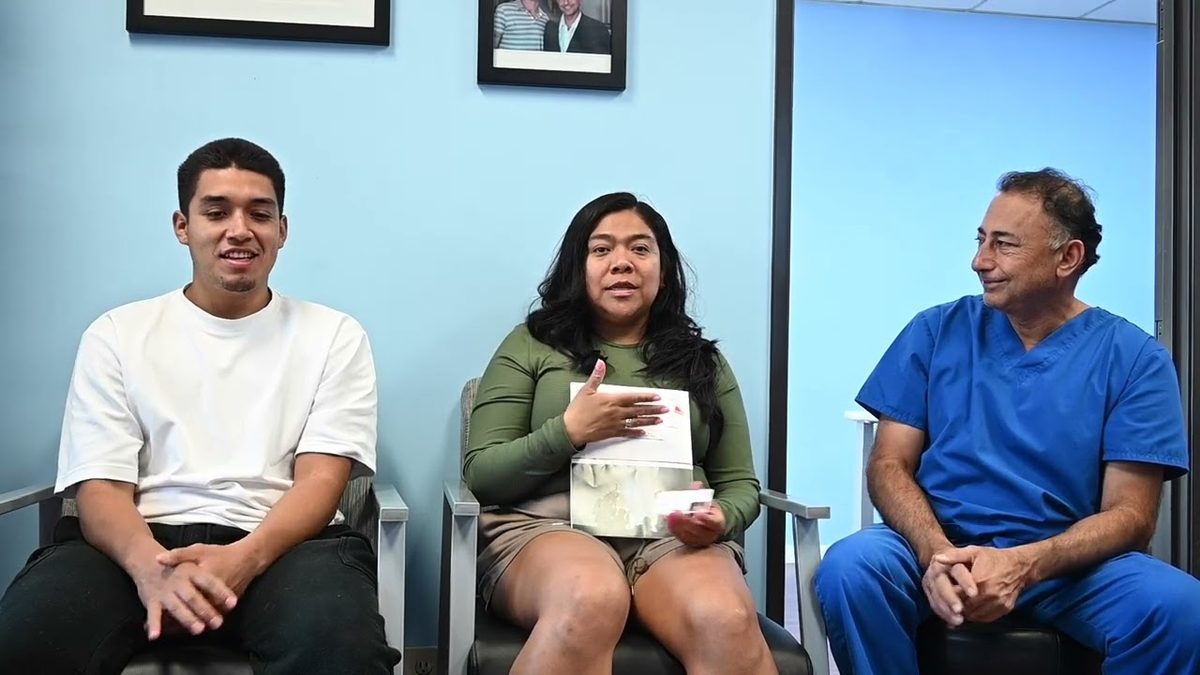
For years, teachers sent Natalie home with notes to get her son Christian's eyes checked, and the checks never gave her an answer. In this video, she and Christian talk with Rajesh Khanna, MD, of Khanna Vision Institute about keratoconus in young people: the glasses that stopped helping, the night driving that pushed the family to act and their advice to other parents. This is one family's experience, and results vary.
When should a child see a cornea specialist?
Natalie's advice to other parents: if "2 to 3 teachers" have already suggested a vision check, "maybe consider taking them to a specialist." Christian got glasses, but a year later he told her he could not see. Another doctor's office then referred them to Dr. Khanna.
How is keratoconus found in a child?
Dr. Khanna says diagnosis uses specialized machines that are quick, painless and no-touch, so even a 10-year-old can be checked. Keratoconus makes the cornea thinner and more cone-shaped, which can distort vision. Dr. Khanna discusses genetics, allergies and eye rubbing as relevant factors. Corneal imaging helps assess shape and thickness and track changes over time. The American Academy of Ophthalmology notes that keratoconus often begins in the late teens or early 20s.
What did night driving have to do with their decision?
Christian has been holding off on a driver's license "just due to vision reasons." He does not feel comfortable driving at night, and freeway signs can be hard to read, though daytime has been fine. Natalie says Dr. Khanna had talked with them about CTAK months earlier and they kept going back and forth. Then night driving came, she was gripping her seat as he drove, and she decided: "Let's call and schedule the appointment."
Why is glare so bad with keratoconus?
Dr. Khanna says the glare Christian describes comes from a cornea that is not smooth, so light gets disrupted as it enters and a car at night can show fuzzy borders. CTAK, or corneal tissue addition keratoplasty, aims to reshape the cornea by adding donor tissue. A more regular shape may improve how light focuses, but improvement varies.
How is CTAK different from cross-linking?
Cross-linking is about slowing progression: it stiffens the cornea. At our practice it is offered as Epioxa, with insurance approval only. CTAK is about shape. Our CTAK page explains that it adds custom donor tissue to improve the shape of the cornea. CTAK is newer, and published studies so far are small, so we do not call it a cure or promise that a transplant will be avoided. For a general overview, see our earlier post on CTAK for keratoconus in Los Angeles.
What does Christian say about his experience so far?
Christian says that since his CTAK operation he has noticed his vision improving, and he hopes for more as his eye heals. He would "100% recommend" it to other young people who are nervous. That is his own experience, not a promise; results differ from person to person.
Why does Dr. Khanna warn against eye rubbing?
Christian admits he rubbed his eyes a lot as a child. Dr. Khanna explains that rubbing pushes the cornea up, so you may see better for a moment, but over time it harms the eye. Avoid rubbing and ask your eye doctor how to manage itching or allergies. Properly fitted rigid gas-permeable or scleral lenses can improve vision in keratoconus; they do not stop the disease from progressing. Your specialist can explain the difference between correcting vision and stabilizing the cornea.
What should you ask at a keratoconus evaluation?
- Is my cornea (or my child's) changing, and how is it measured?
- Do I need cross-linking, CTAK, both or only monitoring?
- How does insurance authorization work? Natalie advises asking your insurer early.
How do you get started?
You can start with a video call from home, then come in for corneal scans. Your examination determines which treatments are suitable, and the number of visits depends on the care you need. Call Beverly Hills at (310) 482-1240 (9100 Wilshire Blvd, Suite 265E, Beverly Hills, CA 90212) or Westlake Village at (805) 230-2126 (31824 Village Center Rd, Suite F, Westlake Village, CA 91361).
Frequently asked questions
Is CTAK a cure for keratoconus?
No. CTAK aims to improve the shape of a cornea changed by keratoconus. It does not cure the disease, and we cannot promise any particular vision or that a corneal transplant will never be needed.
Can a child be checked for keratoconus?
Yes. In the video, Dr. Khanna says the corneal scans used to diagnose keratoconus are quick, painless and no-touch, and that a child as young as 10 can be checked.
Does rubbing my eyes really matter?
It can. Rubbing may make things look clearer for a moment, but over time it can harm a cornea that is already thin, and the American Academy of Ophthalmology says it can make keratoconus worse.
Is there a free keratoconus consultation?
No. We offer free keratoconus education. The evaluation is a keratoconus exam: a VIP lifestyle exam for self-pay patients, or an annual eye exam through insurance. We accept PPO insurance plans. We do not accept HMO or Medi-Cal plans.
Rajesh Khanna, MD is a board-certified ophthalmologist and UCLA clinical instructor, Jules Stein Eye Institute, with 25+ years in practice and 25,000+ procedures.