

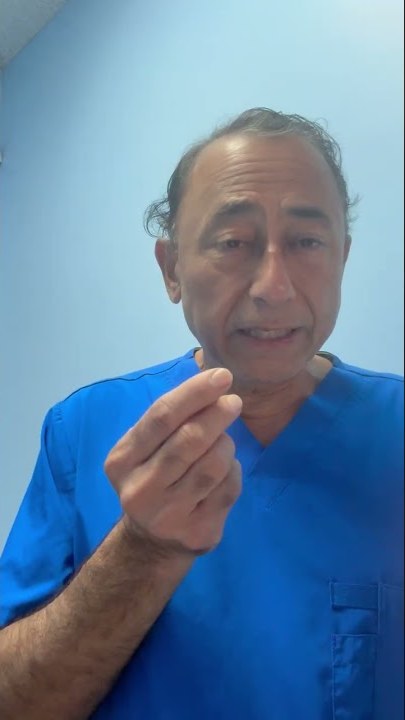
“Choosing the best implant for your eyes in 2026.” That is how Dr. Khanna starts this short video, and then he smiles at how many options now exist: “Today we have so many implants it’s more than my fingers on my hand and even my toes.” The point of the clip is not that you should memorize every name. It is that the surgeon’s job is to match a lens to your life.
Why shouldn’t you have to pick the lens alone?
He asks a fair question: if a patient is told to go research a long list of implants, “then what are we paying the doctor the surgeon for?” In his words, he and his team work to understand your lifestyle and your goals for vision. An active skier does not need the same thing as someone on a computer sixteen hours a day. A nurse who reads the back of bottles many times a day does not need the same thing as someone who wants very good distance and only occasionally reads up close.
What else shapes the choice?
He also talks about the eye itself: the shape of the cornea, the length of the eye, and what is in the other eye. For people who have had radial keratotomy or have corneal scars, he notes that a light adjustable lens can be helpful because it can be adjusted later. After LASIK, he says many implants can work, including PureSee, a presbyopic implant that is FDA-approved for cataract surgery and used off-label for refractive lens content exchange (popularly called refractive lens exchange, or RLE). He also cautions that some designs, such as Odyssey from the same company, should not be used if the optical zone is smaller. Those are his points in this video, and they belong in a private exam, not in a one-size-fits-all rule.
How do we talk about a 'best' implant?
There is no single best lens for every person, and no implant comes with a promised result. You can read more about which lens may fit your eyes on our site, and about PIE (presbyopic implant in eye) if you are over 45. The consult for PIE is free. We do not list a monthly implant price, because none is approved for this procedure.
Every eye is different, and results vary. No one can promise a specific result, and Dr. Khanna will tell you honestly what is realistic for your eyes.
Who this video is for
It is for people over 45 who feel overwhelmed by lens brand names, for people with a history of radial keratotomy, corneal scars or prior LASIK, and for adult children helping a parent get ready for a consult in Beverly Hills or Westlake Village.
Can you start without a long drive?
Yes. You can begin with a Free VIP Photo and/or Video Consult from home, and the process takes only a few visits. Consults for PIE are free. We have two offices. Call Beverly Hills at (310) 482-1240 (9100 Wilshire Blvd, Suite 265E, Beverly Hills, CA 90212) or Westlake Village at (805) 230-2126 (31824 Village Center Rd, Suite F, Westlake Village, CA 91361). We accept PPO plans only. We do not accept HMO plans or Medi-Cal.
Frequently asked questions
Is there one best implant in 2026?
No. In this video Dr. Khanna says the choice depends on your lifestyle, your goals, and the details of your eyes.
Do I have to travel for the first visit?
No. You can start with a Free VIP Photo and/or Video Consult from home, then come to Beverly Hills or Westlake Village for the visits that need to be in person.
Rajesh Khanna, MD has over 25 years in practice and has performed 25,000+ procedures.